
Fitting Personal Training Around a Busy Work Week
The most common reason people on the Northern Beaches put off training isn’t motivation or cost. It’s time.
Here’s what usually happens. Someone gets in touch saying their lower back’s been aching by mid-afternoon, their shoulders feel permanently rounded forward, and their neck is stiff by the time they leave the office.
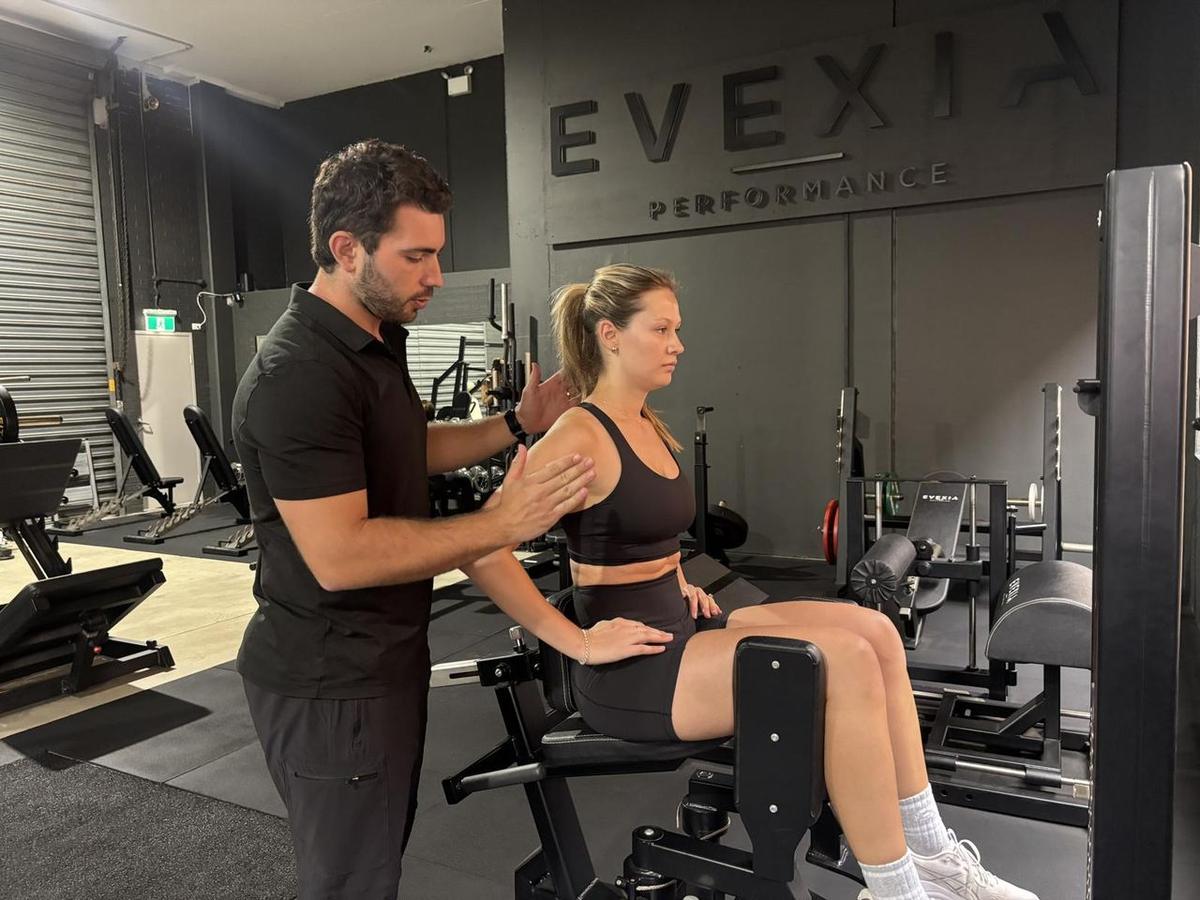
Here’s what usually happens. Someone gets in touch saying their lower back’s been aching by mid-afternoon, their shoulders feel permanently rounded forward, and their neck is stiff by the time they leave the office. Almost always, it’s someone who sits at a desk most of the day, and they’ve usually already tried the obvious fix, a few stretches here and there, without much to show for it.
If this sounds familiar, you’re not alone. Desk work has become the default for millions of people, and the physical toll accumulates quietly. You don’t wake up one day with a postural problem; it creeps in gradually as your body adapts to eight, nine, sometimes ten hours a day in the same position. By the time you notice it, the adaptation has usually been running for months or years.
Stretching is the first thing most people reach for, and it feels like it should work. In practice, a quick stretch tends to buy twenty minutes of relief before you’re right back where you started. That’s because sitting all day isn’t really a flexibility problem on its own. It’s the position your body’s spent eight hours adapting to, and undoing that takes more than holding a stretch for thirty seconds.
Here’s the mechanical reality: when you sit hunched over a desk, your chest muscles tighten, your shoulder blades get pulled forward, and the muscles between your spine and shoulder blades lengthen and weaken under sustained load. Your hip flexors shorten from being bent for hours, your glutes switch off, and your core muscles essentially take a break. A thirty-second stretch can’t reverse eight hours of postural adaptation. You’d need to spend more time stretching than you spent creating the problem in the first place, and that’s neither practical nor sustainable.
The real fix requires loading the muscles that have switched off and mobilizing the structures that have tightened. That’s strength work and deliberate movement practice, not stretching alone. Our semi-private training sessions are specifically designed around this principle, combining mobility work with progressive strength building.
There’s plenty of generic exercise lists floating around online already. The trouble is, what’s actually tight, weak, or restricted is different for everyone. Some desk workers have primarily tight chest and shoulders. Others have dominant lower back pain that stems from weak glutes and an anterior pelvic tilt. Still others have upper back stiffness that comes from forward head posture and weak upper back muscles.
Handing the same five exercises to every desk worker on the Northern Beaches isn’t going to fix any one person’s specific pattern. It’s like giving everyone the same prescription glasses based on the assumption that everyone has the same vision problem. It might help someone, but it’ll probably miss the mark for most people. Desk worker issues in Brookvale are common enough that we’ve refined our approach specifically for this demographic.
This is the part no article, this one included, can really do for you. An article can explain the problem and point toward solutions, but it can’t assess your movement, identify which specific structures need attention, or build a progressive program around your individual pattern.
If this sounds familiar, the right next step is having someone look at how you’re actually moving, not guessing from a checklist. In a consultation, a coach gets a proper look at where you’re restricted, how your spine’s positioned, whether your shoulder blades are tracking properly, and how your hips and core are functioning. That assessment shapes a program that’s built around your actual limitations rather than a one-size-fits-all routine.
The program usually involves some combination of mobility work, getting stuck joints moving again, activation exercises, waking up muscles that have gone quiet, and progressive strength work, building the capacity to hold better posture under load. It takes consistency, usually two to three sessions a week for several weeks, but the difference is noticeable. People report less pain, better energy throughout the day, and a sense that their body feels more resilient again. Read about what other desk workers have experienced with our coaching.
The program also needs to account for the reality that you’ll keep sitting at a desk. The goal isn’t to eliminate desk work, it’s to build enough resilience that eight hours at a desk doesn’t leave you in pain or feeling broken by the end of the day.
If you’re tired of the twenty-minutes-of-relief cycle and you want something that actually sticks, the next step is getting a proper assessment. That means looking at your movement, your posture, your history, and your goals, then building something specific to you.
Book a free consultation with Solve Personal Training. We’ll take a proper look at what’s going on with your posture, explain what we’re seeing, and outline what a realistic program would actually involve. Check our pricing to understand your investment, or learn about semi-private vs 1-on-1 training to decide which format works best for you. No guessing, no generic lists. Just an honest assessment and a path forward.
A free 45-minute consultation covers your history, your goals and a movement assessment — then a plan you can actually follow.

Bachelor of Science with Dean’s Award for Academic Excellence and a nationally recognised Nutritionist specialising in sustainable fat loss and body composition. Writes every program and leads the coaching at Evexia Wellbeing, Brookvale. More about Max →
Keep reading
The most common reason people on the Northern Beaches put off training isn’t motivation or cost. It’s time.
On paper, semi-private training and group fitness classes look similar. Both involve training alongside other people, both cost less than one-on-one coaching, and both run at set times.
Free 45-minute consultation
A free 45-minute consultation covers your training history, your goals and a movement assessment — with no obligation to continue.
Evexia Wellbeing, Unit 1/27 Dale St, Brookvale NSW 2100 · Parking on site